How Should Advertisers Think About Keywords in ChatGPT Ads?
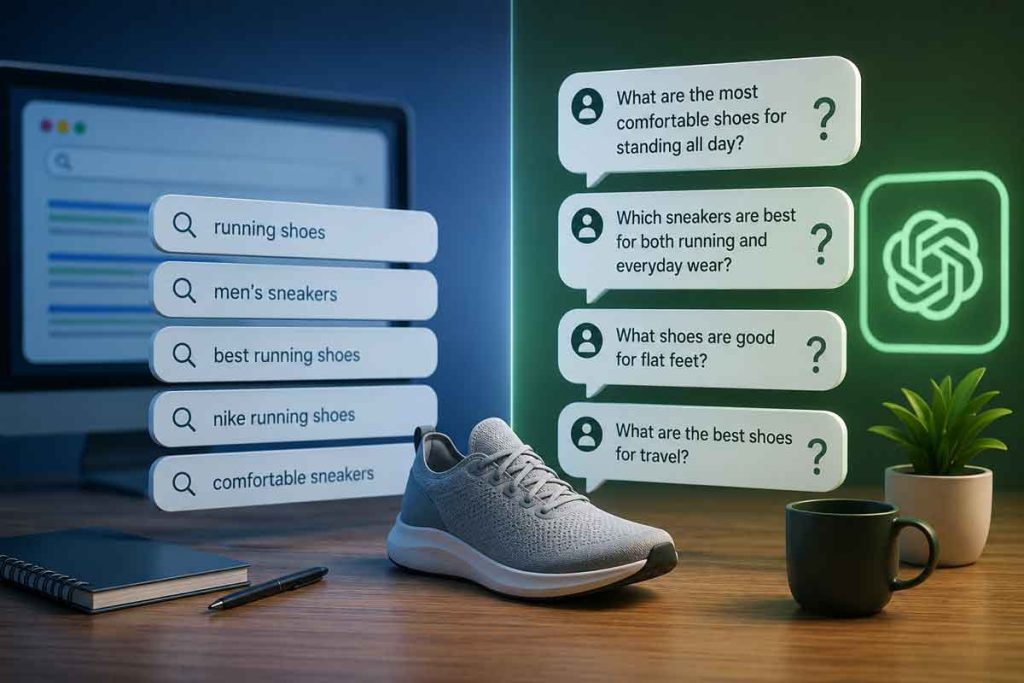
One of the more pressing questions emerging from OpenAI’s advertising platform is how advertisers should approach keyword targeting — and how that choice intersects with whether you are buying on a cost-per-click (CPC) or cost-per-thousand-impressions (CPM) basis. Traditional Google Ads campaigns have trained marketers to think in fragments — “running shoes,” “men’s sneakers,” “waterproof hiking boots.” These short phrases align with how users have searched on Google for the past two decades, and they were built around CPC economics where every click costs money.
ChatGPT introduces a fundamentally different opportunity. Instead of relying solely on those fragments, advertisers may want to test longer, question-style phrases like “what are the best running shoes for flat feet,” “what shoes should I wear for a half marathon,” or “how do I choose between trail and road running shoes.” Since users interact with AI assistants through complete questions and conversational threads, these longer phrases may be a closer match to how people actually communicate — and how the platform’s matching logic works. The CPC vs CPM question matters here too: broad conversational targeting paired with CPM pricing could burn budget fast, while the same targeting under CPC is far more forgiving. For a broader look at how the platform works before you spend a dollar, see How to Set Up ChatGPT Ads: Advertiser Requirements and Platform Access.
Why Traditional Keyword Fragments Still Make Sense
Traditional keyword targeting has real advantages. Advertisers have decades of paid search data showing that users querying “buy running shoes” or “men’s size 11 Nike” are often close to a purchase decision. These searches signal commercial intent and tend to produce more qualified traffic — which matters whether you are paying per click or per thousand impressions.
Under a CPM model, tight keyword targeting is especially important. If you are paying for every impression regardless of whether anyone clicks, you want those impressions showing up in highly relevant conversations, not loosely related ones. Under CPC, the stakes are lower per placement, but precision still reduces wasted spend and improves conversion rates. If OpenAI’s matching system places meaningful weight on advertiser-provided keywords, tight commercial fragments could result in more focused placements and stronger returns under either pricing model. ChatGPT Ads vs Google Ads: When to Use Each Platform breaks down where each platform fits within a broader paid strategy.
Could Question-Based Targeting Work Better?
The counterargument is that AI conversations are structurally different from search engine queries. Users are asking complete questions, explaining goals, comparing options, and seeking recommendations — often within a single session. A phrase like “what running shoes are best for knee pain” may be more representative of an actual ChatGPT exchange than simply “running shoes.”
Whether question-based targeting is a smart bet depends heavily on your pricing model. On CPM, broad question-style phrases could generate a high volume of impressions from users who are still early in the research process and unlikely to convert — meaning you pay for reach without results. On CPC, that same broad targeting becomes much more viable: you gain brand visibility across a wide range of relevant conversations, but you only pay when someone is engaged enough to click. Since the platform currently limits access to select advertisers, Contextual Targeting in ChatGPT Ads: Strategy Without Demographics covers how to build an effective approach without traditional audience data.
| Traditional Keyword Style | Question-Style Phrase |
|---|---|
| running shoes | what are the best running shoes for flat feet |
| mens sneakers | what sneakers are best for standing all day at work |
| hiking boots | what boots should I wear for a weekend hiking trip |
| waterproof shoes | what are the best waterproof shoes for rainy weather |
| shoe brand | how do I pick the right shoe brand for wide feet |
Potential Benefits of Testing Question-Based Phrases
- Closer alignment with natural AI conversation patterns.
- Potential for broad brand exposure — especially valuable under CPC where impressions carry no direct cost.
- Opportunity to reach users earlier in the research and consideration phase.
- May capture conversational intent that traditional keyword tools never surface.
Why CPC vs CPM Changes Everything About Risk
The pricing model you are on may matter more than the keywords you choose. Under CPM, every impression has a cost — which means broad, informational targeting can drain budget on users who are nowhere near a purchase. A user asking “what are good shoes for plantar fasciitis” is probably still researching. Under CPM, showing up in that conversation costs real money regardless of outcome.
Under CPC, that same placement is essentially free if the user does not click. That fundamentally changes how aggressively you can afford to target informational, question-style queries. A shoe brand on CPC can afford to appear in dozens of early-funnel conversations about arch support, shoe sizing, and material comparisons — paying only when someone is interested enough to engage. The same strategy under CPM could easily produce a poor return. Understanding exactly which model applies to your campaign before you launch is not optional. ChatGPT Ads Pricing: CPM Models, Budgets, and ROI Planning covers the current landscape in detail.
A practical rule of thumb: if you are on CPM, lean toward tighter, higher-intent keyword fragments. If you are on CPC, broader question-style targeting becomes far more defensible as a strategy.
Why Some Advertisers May Prefer Traditional Keywords Regardless of Pricing Model
- Short commercial phrases typically signal stronger purchase intent under both CPC and CPM.
- Tighter targeting reduces impression waste, which matters most on CPM.
- Campaign segmentation is easier to manage and explain to stakeholders.
- Performance can be benchmarked against years of existing PPC data.
Testing Both Approaches Is Probably the Right Move
OpenAI has not publicly disclosed exactly how keyword matching and conversational context interact within its advertising system — or definitively settled whether CPC or CPM will be the dominant pricing structure for most advertisers. Until that changes, every assumption should be treated as a hypothesis rather than fact.
A practical approach: build separate ad groups using different targeting philosophies, and wherever possible, test them under the same pricing model so you are comparing apples to apples. One group targets “running shoes” and “men’s sneakers.” The other targets “what running shoes are best for beginners” and “how do I know if I need motion control shoes.” If you have access to both CPC and CPM options, running the same keyword sets under each model can reveal whether pricing structure or targeting style has a bigger impact on your results. This is also where attribution setup matters significantly — ChatGPT Ad Tracking: Complete UTM and Attribution Guide walks through how to measure results correctly from the start.
Advertisers who gain the most from ChatGPT Ads will likely be the ones who treat both keyword strategy and pricing model as variables to test, rather than assuming that Google Ads playbooks transfer directly. For a longer-term read on where this is all heading, The Platform Lifecycle: What ChatGPT Ads Tell Us About the Future of Digital Advertising is worth a read.
What We Would Test First
If we were launching a ChatGPT Ads campaign for a shoe brand today, we’d start by confirming whether the account is on CPC or CPM — because that single variable should drive the initial keyword strategy. On CPC, we’d launch with a mix of traditional fragments and question-style phrases to see which gets traction. On CPM, we’d start tighter with commercial-intent keywords and expand only after we understood our cost-per-impression baseline.
From there, we’d build parallel ad groups and let click-through rate, conversion rate, assisted conversions, and cost per acquisition drive decisions. As more advertisers enter the platform and benchmarks develop, keyword strategy combined with smart pricing model selection may become the key variables separating profitable ChatGPT campaigns from wasted spend.
If you’re planning to add ChatGPT Ads to your mix, our Search Engine Marketing services and SEO services are built to work alongside emerging AI ad channels — not in isolation from them. Get in touch if you want to talk through a testing strategy.