On May 19, 2026, at Google I/O, Google did something it hasn’t done in over two decades — it fundamentally redesigned the search box. Not the results page. Not a new experimental tab buried in Labs. The actual box. The one that has launched hundreds of billions of searches and, until now, hadn’t meaningfully changed since the early 2000s.
I want to walk through what this is, why I think Google did it, and what I think it means — for your traffic, your content, your ad spend, and honestly, for how we all think about SEO going forward.
What Is Google’s New Intelligent Search Box?
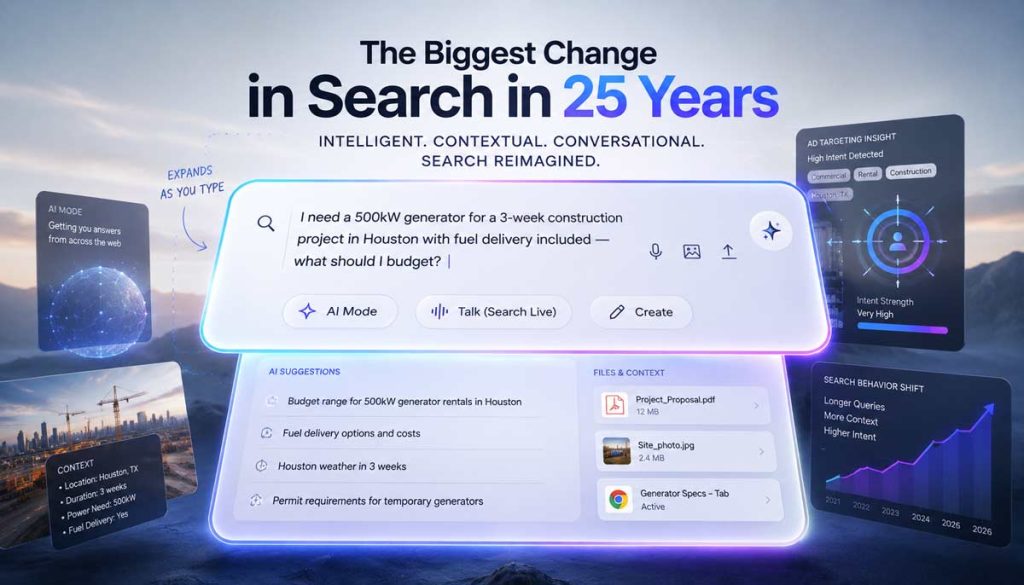
Google is calling it the Intelligent Search Box, and the changes are real. Here’s what’s actually different, rolling out globally as of May 19 in all countries and languages where AI Mode is available:
- It expands as you type. The old single-line box quietly trained users to think in short fragments — two or three keywords, nothing more. The new box grows dynamically to accommodate longer, more conversational queries. Google is literally making room for you to explain yourself.
- AI-powered suggestions that go beyond autocomplete. Instead of just finishing your words, the intelligent search box tries to anticipate your intent — not just your syntax. Google’s Head of Search, Liz Reid, specifically described this as suggestions that “go beyond autocomplete.”
- Multimodal input. You can now drop in text, images, files, videos, or open Chrome tabs as part of your search. Ask about the PDF you’re reading. Search from an image on your screen. Use an open browser tab as context for your query.
- Built-in AI Mode shortcuts. Directly below the text box are quick-access buttons for AI Mode, Talk (Search Live), and Create — Google’s most powerful AI tools sitting right there before you’ve typed a single character.
The whole thing is powered by Gemini 3.5 Flash, now the default model for Google AI Mode globally. AI Mode hit one billion monthly users in the year since its debut at I/O 2025, with queries more than doubling every quarter. And here’s a number worth noting: overall search queries hit an all-time high last quarter. People aren’t searching less because of AI. They’re searching more.
Why I Think Google Did This
The timing is obviously AI-driven, but I think the real reason is simpler than the headlines suggest: user behavior changed, and the old search box stopped serving it.
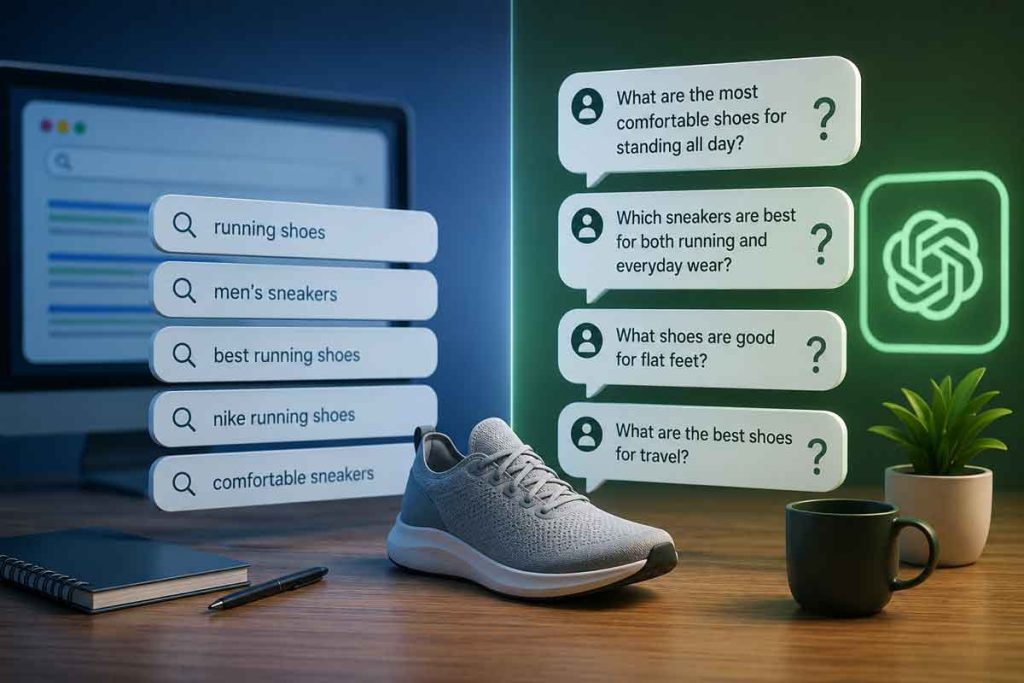
People have been typing longer, messier, more natural questions into Google for years — partly because voice search trained them to, partly because ChatGPT trained them to expect a conversational interface. The box stayed narrow while the queries kept getting wider. This redesign closes that gap. It’s UX catching up to behavior.
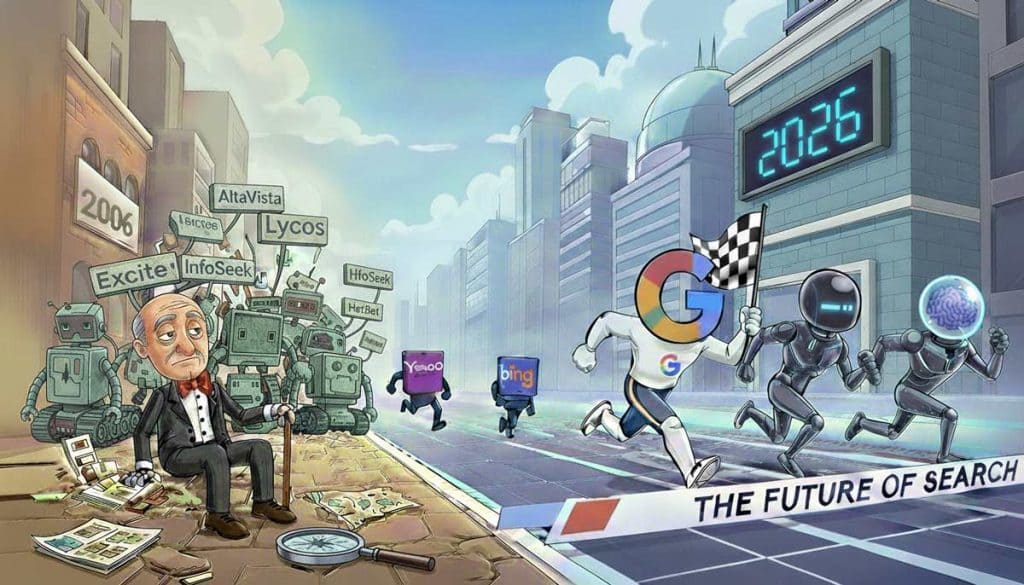
There’s also a competitive angle I’d be naive to ignore. ChatGPT, Perplexity, and other AI-native tools have conditioned users to think in prompts. Google needed the default experience to feel just as natural. With the intelligent search box, it does — and more importantly, Google controls the starting point again. By redesigning the entry point, they route more users naturally into AI Mode and AI Overviews without requiring anyone to opt in or find a separate tab. It’s a subtle but powerful funnel.
What This Means for SEO — And Why I’m Not Panicking
Here’s where I’ll give you my honest take: nothing comes from nothing.
Google AI Mode, AI Overviews, and the intelligent search box all need content to synthesize, cite, and summarize. They don’t conjure answers out of thin air — they pull from the web. Your content is the raw material. If you stop producing it, let it go stale, or keep it shallow, you don’t just fall out of traditional rankings. You disappear from AI-generated answers too. The two are more connected than people seem to realize right now.
I’ve been thinking a lot about how AI answer engines change what optimization even means — and the intelligent search box accelerates that conversation. When users can submit a fully-formed question with context, uploaded files, and images all at once, the queries being matched to your content will look very different from “best generator rental Houston.” They’ll look more like: “I need a 500kW generator for a three-week construction project in Houston with fuel delivery — what should I budget for that?”
That’s a richer query. Content that speaks to that level of specificity — the use case, the logistics, the real decision criteria — is far more likely to get cited in an AI-generated answer than content built around the short version of the keyword.
A few things I’m watching closely:
- Click-through rates will keep falling. The intelligent search box routes more users into AI Mode faster, which means more AI Overviews, which means fewer clicks to your site. Already over 58% of Google searches end without a click. I expect that number to keep climbing.
- Long-tail and intent-specific content becomes more valuable, not less. Longer, more specific queries need longer, more specific content to match. This isn’t bad news if your content is actually good.
- Topical authority is the new moat. If Google’s AI systems recognize your site as a credible source on a specific subject, it will cite you. That trust gets built through consistent, substantive content over time. There’s no shortcut for it.
- Rank tracking alone won’t tell you what you need to know. I’d start monitoring whether you appear in AI Overviews and AI Mode answers. That’s the visibility metric that’s going to matter more and more.
Here’s the Ads Angle Nobody Is Talking About Yet
This is honestly the part I find most interesting — and most underreported in the coverage I’ve seen coming out of Google I/O.
When someone submits a plain two-word keyword, Google knows relatively little about their real intent. When someone types a full paragraph — with context, constraints, uploaded documents, and a continued conversation — Google knows a lot. That contextual signal is extraordinarily valuable for ad targeting, and it’s richer than anything Google has had access to before at this scale.
I’ve been thinking about this through the lens of how AI platforms are building ad models around context rather than demographics — and what Google is building here is that same idea, but with the reach and infrastructure of the world’s largest ad platform behind it. The intent expressed in a detailed, natural-language query tells an advertiser more than a hundred behavioral data points. “I need to rent a 500kW generator in Houston for three weeks with fuel delivery” is more actionable than your device type, age bracket, and browsing history combined.
Google will use this. I’d be shocked if they don’t. The intelligence going into that search box is going to flow directly into the ad auction — smarter placement, richer targeting, and eventually ad formats we haven’t seen yet that are designed specifically for a conversational search interface. This isn’t speculation about whether it happens. It’s speculation about when, and what it looks like when it does. Watch this space.
So Where Does That Leave You?
My honest advice: don’t panic, and don’t wait for everything to settle before you act, because it won’t settle for a while.
- Keep creating content — but make it earn its place. Thin content built to rank for a single keyword is already dying. Content that genuinely explains, answers, compares, and guides gets cited in AI answers. Write for the question behind the query, not just the query itself.
- Structure your content so AI can extract from it cleanly. Clear headings, direct answers near the top of each section, logical flow. This is just good writing discipline — it also happens to be exactly what makes content easy for AI systems to pull from and attribute.
- Start measuring AI visibility alongside rankings. Are you showing up in AI Overviews? Is your brand getting cited in Google AI Mode answers? Get visibility into this now, before it becomes obvious that you should have been tracking it all along.
- Review your paid search setup with longer queries in mind. Broad match, Performance Max, and audience signals all behave differently against rich, conversational queries. It’s worth a close look at how your campaigns are positioned for this shift.
- Go deeper on topics, not just broader. A tight cluster of well-linked, substantive articles on a specific subject signals authority to both traditional algorithms and AI systems. One surface-level post on a topic won’t make you a cited source in anything.
At the end of the day, Google still needs content to be Google. Every AI Overview, every AI Mode answer, every contextual ad signal traces back to something someone wrote, published, and made findable on the web. Your content is still the fuel. The engine just got a lot more sophisticated about how it uses it — and a lot more demanding about the quality it requires.
The question isn’t whether to keep creating content. It’s whether what you’re creating is good enough to be worth citing.
If you want to work through what that looks like for your site specifically, let’s talk.