

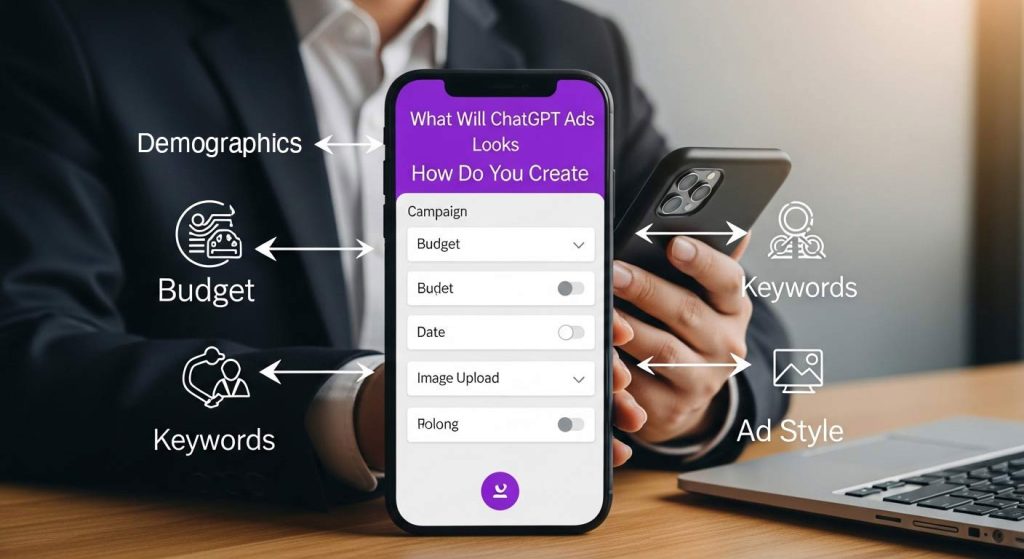
What Will ChatGPT Ads Actually Look Like?
OpenAI has described the basic format but hasn’t released visual examples or detailed specifications. According to the company’s help documentation, “Ads will be clearly labeled and separated from the conversational content.” This suggests a distinct visual treatment that differentiates sponsored placements from ChatGPT’s organic responses. The ads will appear “at the bottom of responses,” indicating placement after the AI-generated answer rather than within or before it.
Based on this description and similar implementations on other platforms, ChatGPT ads will likely be text-based placements with minimal visual elements—closer to Google search ads than to Instagram’s image-heavy sponsored posts. The conversational interface doesn’t support complex media formats, and maintaining user experience requires that ads integrate cleanly without disrupting the flow of conversation. Expect simple, concise ad units that prioritize clarity and relevance over visual complexity.
ChatGPT’s own analysis provides additional insight into the creation process: “While exact details aren’t public yet, it’s likely you’ll prepare short, text-based ad copy aligned with the conversational context.” This reinforces the expectation of straightforward text ads rather than rich media. For agencies managing Google Ads campaigns, the creative format should feel familiar—headline, description, destination URL—but the messaging approach may need adaptation for conversational contexts.
As discussed in our comprehensive ChatGPT advertising guide, the platform’s unique positioning in the consideration stage requires ads that feel helpful rather than promotional. Users aren’t scrolling through an entertainment feed or actively searching for vendors—they’re engaged in conversations with an AI assistant. Ads that interrupt or feel salesy will likely perform poorly compared to those that provide genuinely useful recommendations aligned with user questions.
How Will Advertisers Create ChatGPT Ads?
The ad creation process hasn’t been publicly documented, but based on industry patterns and ChatGPT’s own guidance, we can construct a reasonable framework. According to ChatGPT, “You’ll probably define landing pages and broad intent categories, then the platform will match your ad to relevant queries.” This suggests an interface where advertisers specify targeting parameters (conversation topics, categories) and provide creative assets (ad copy, destination URLs), with the platform handling the matching logic.
ChatGPT further explains that advertisers should “expect a process similar to writing responsive search ads—you’ll input multiple variations, and the system handles placement.” This implies a dynamic creative approach where the platform may mix and match different headlines and descriptions based on conversation context, similar to Google’s Responsive Search Ads. Advertisers would provide multiple headline options and description options, and ChatGPT’s system would select the most relevant combinations for specific user queries.
The creation workflow likely follows a familiar pattern: campaign setup (budget, targeting, scheduling), creative development (headlines, descriptions, URLs), review and approval (OpenAI may manually review ads before they go live), and then launch with ongoing optimization based on performance data. For agencies accustomed to marketing automation workflows, the process should feel straightforward once platform access becomes available.
Expected ad creation workflow
This anticipated workflow mirrors standard advertising platform setup processes, adapted for ChatGPT’s conversational context and privacy-first approach.
- Campaign setup: Define budget, geographic targeting (if available), and campaign scheduling parameters
- Topic targeting: Select conversation topics or categories where ads should appear (e.g., “CRM software,” “travel planning,” “marketing tools”)
- Creative assets: Provide multiple headline variations (likely 3-5 options) and description text (likely 2-3 variations)
- Landing page configuration: Specify destination URLs with proper UTM tracking parameters (see our attribution guide)
- Review and approval: Submit for platform review to ensure compliance with brand safety and content policies
- Launch and monitor: Campaign goes live, with performance tracking through OpenAI’s reporting dashboard
What Makes Effective ChatGPT Ad Copy?
Writing for conversational contexts requires different approaches than traditional display or search advertising. Users engaging with ChatGPT are in a help-seeking mode, actively requesting guidance rather than passively consuming content. Ads that feel like natural extensions of that guidance—”here’s a solution to what you just asked about”—will outperform ads that feel like promotional interruptions.
Effective ChatGPT ad copy likely emphasizes utility and relevance over brand awareness or emotional appeal. Instead of “Transform Your Business with Our Revolutionary CRM,” think “CRM built for small sales teams—free 14-day trial.” The former feels like generic marketing speak; the latter answers a specific need with clear qualification and a low-friction offer. The conversational context rewards specificity and clarity over aspirational messaging.
ChatGPT’s guidance suggests that ads should be “short, text-based ad copy aligned with the conversational context.” This implies character limits similar to Google search ads—enough space to communicate value proposition and differentiation, but not enough for lengthy explanations. Advertisers must distill their offering to its essence: who it’s for, what problem it solves, and what action to take. For companies with complex products or services, this forcing function can actually improve marketing clarity across all channels.
Ad copywriting principles for conversational AI
These guidelines help create ad copy that resonates in ChatGPT’s conversational environment rather than feeling like disruptive promotions.
- Answer the question: If the user asked “what’s the best CRM,” your ad should directly address CRM selection criteria, not just promote features
- Be specific, not generic: “For teams of 10-50” converts better than “for businesses of all sizes” because it helps users self-qualify fit
- Lead with differentiation: Explain what makes your solution different, not just what category it’s in
- Use conversational language: Write like you’re recommending something to a colleague, not broadcasting a marketing message
- Include clear qualification: Help users understand if your solution is right for them (price point, use case, company size)
- Emphasize outcomes, not features: “Close deals 30% faster” resonates more than “includes email integration”
- Make the offer obvious: What happens when they click? Free trial, demo, consultation, pricing calculator—be explicit
How Many Ad Variations Should You Create?
If ChatGPT follows Google’s responsive ad model, the platform may request multiple headline and description variations that it can mix and match for optimal relevance. Google’s Responsive Search Ads allow up to 15 headlines and 4 descriptions, though best practices suggest starting with 8-10 headlines and 3-4 descriptions to provide variety without overwhelming the testing matrix.
For ChatGPT, the optimal number of variations depends on two factors: how much the platform’s algorithm needs to work with, and how many genuinely distinct value propositions your offering has. Creating 15 headlines that all say essentially the same thing in slightly different words doesn’t help—the algorithm needs meaningful variation to test different angles and determine what resonates with different conversation contexts.
A strategic approach is to create headlines that emphasize different value propositions: speed, cost-efficiency, ease of use, specific features, integration capabilities, customer support, industry specialization. This gives the platform’s matching algorithm real options to optimize around. For companies managing SEO content strategies alongside paid advertising, the same differentiation frameworks that inform content clusters can guide ad variation development.
Ad variation strategy
These variation types provide meaningful diversity for the platform’s optimization algorithm rather than superficial rewording of the same message.
| Variation Type | Example Headlines | When It Resonates |
|---|---|---|
| Speed/Efficiency | “Get started in 10 minutes” / “Set up in under an hour” | Users asking about ease of implementation |
| Cost/Value | “Starting at $49/month” / “Free for teams under 10” | Price-sensitive conversations or budget discussions |
| Feature-Specific | “Built-in email automation” / “Native Salesforce integration” | Conversations about specific functionality requirements |
| Use Case | “CRM for B2B sales teams” / “Built for real estate agents” | Industry or role-specific queries |
| Social Proof | “Trusted by 50,000+ teams” / “4.8-star rating on G2” | Users seeking validation or comparing options |
What Landing Page Experience Works Best?
Landing pages for ChatGPT traffic require different optimization than pages built for search or social traffic. Users arriving from conversational AI contexts may have spent several minutes discussing their problem with ChatGPT before clicking an ad—they’re informed, they understand their needs, and they’re evaluating specific solutions. This is different from cold display traffic (low awareness) or hot branded search traffic (already convinced), requiring a middle-ground approach.
The landing page should acknowledge the conversational context without being overly cute about it. Don’t say “Welcome, ChatGPT user!”—that feels gimmicky. Instead, lead with clarity about what the solution does, who it’s for, and what differentiates it from alternatives. Users who just discussed “best CRM for small sales teams” with ChatGPT don’t need basic CRM education—they need specific information about your pricing, features, and what makes you the right choice for small sales teams specifically.
Landing page length and depth should match the complexity of the purchase decision. High-consideration B2B software might need longer pages with detailed feature explanations, case studies, and comparison charts. Simple, low-friction offers like newsletter signups or free tools can use shorter pages focused on value proposition and form completion. For agencies managing marketing analytics across multiple channels, A/B testing different landing page approaches specifically for ChatGPT traffic helps optimize conversion rates.
Landing page optimization for ChatGPT traffic
These design and content principles help landing pages convert users arriving from conversational AI contexts effectively.
- Clear value proposition above fold: Users should immediately understand what you offer and who it’s for without scrolling
- Answer likely objections: If ChatGPT discussed pricing, competitors, or limitations, address these directly on the page
- Provide comparison context: Users are evaluating options—help them understand how you compare without requiring additional research
- Make pricing transparent: If users asked about cost, hiding pricing behind forms creates friction and reduces conversion
- Emphasize differentiation: Explain what makes you different from alternatives ChatGPT might have mentioned
- Reduce form friction: Collect only essential information—long forms deter users who just spent time explaining their needs to ChatGPT
- Include trust signals: Reviews, testimonials, security badges, and customer logos validate that ChatGPT’s recommendation is credible
How Do You Test and Optimize Ad Creative?
Without query-level data showing which specific prompts triggered ads, creative optimization relies more heavily on conversion performance than traditional search advertising. You won’t know if headline A performed better because it matched specific user language or because it genuinely resonates more broadly. This shifts testing methodology toward statistical significance on conversion outcomes rather than click-through optimization based on query matching.
The testing process likely follows standard A/B testing principles: run multiple variations simultaneously, gather sufficient conversion volume for statistical significance (typically 50-100 conversions per variation), identify winning combinations, and iterate. If the platform provides topic-level performance data, you might discover that certain headlines perform better in specific conversation categories—cost-focused headlines winning in budget discussions, feature-focused headlines winning in technical comparisons.
Creative testing should also extend beyond the ad unit itself to include landing page variations. Because you can’t refine targeting through negative keywords or audience exclusions, landing page messaging becomes the primary tool for qualifying traffic and improving conversion rates. Testing different headline approaches, value proposition emphasis, and form designs helps optimize the complete funnel from ad impression to conversion.
Creative testing framework
This systematic approach to testing enables continuous performance improvement despite limited query visibility and targeting controls.
- Establish performance baseline: Run initial creative for 2-4 weeks to gather baseline conversion data
- Isolate variables: Test one element at a time (headline emphasis, description length, landing page design) to identify what drives improvement
- Achieve statistical significance: Gather 50-100 conversions per variation before declaring winners to avoid false positives
- Analyze by topic (if available): If OpenAI provides category-level data, segment creative performance by conversation topic
- Test landing page alignment: Create landing pages that specifically address different conversation contexts and test which converts best
- Iterate winners: Once a winning variation is identified, create new tests that build on that insight
- Document learnings: Maintain a testing log to avoid repeating ineffective variations and compound knowledge over time
What About Brand Guidelines and Creative Consistency?
For brands with strict creative guidelines, the constraint of text-only ads in conversational contexts may create tension. If your brand voice emphasizes aspirational, emotional messaging but ChatGPT ads require direct, utility-focused copy, which takes priority? The answer likely depends on where ChatGPT fits in your overall marketing strategy and whether performance or brand consistency matters more for this specific channel.
The pragmatic approach is to view ChatGPT as a performance channel where conversion efficiency matters more than perfect brand expression. This doesn’t mean abandoning brand voice entirely—you can still maintain tone, values, and differentiation—but it does mean prioritizing clarity and relevance over stylistic consistency. Users engaging with ChatGPT are in problem-solving mode, not brand discovery mode, so ads that help them solve problems will outperform ads that try to build emotional connections.
For large organizations managing brand across multiple channels, establishing ChatGPT-specific guidelines can help. Define what constitutes acceptable deviation from standard brand voice in service of performance, identify non-negotiable brand elements that must be maintained, and create approval workflows that balance brand integrity with channel optimization. This structured approach prevents ad-hoc decisions and ensures consistency across campaigns even when adapting for conversational contexts.
Balancing brand and performance
These principles help maintain brand integrity while optimizing for ChatGPT’s unique conversational context and performance requirements.
| Brand Element | Standard Approach | ChatGPT Adaptation |
|---|---|---|
| Messaging tone | Aspirational, emotional | Direct, helpful, conversational while maintaining core voice |
| Value proposition | Broad, universal appeal | Specific, use-case focused, helps users self-qualify |
| Visual identity | Rich media, designed assets | Text-only, maintain voice through copy not visuals |
| Call to action | Brand-specific language | Clear, standard actions (Start free trial, Get demo, See pricing) |
Should You Prepare Creative Assets Now?
Even though the platform isn’t broadly available, preparing creative assets now accelerates deployment when access opens. Developing multiple headline variations, writing description copy that emphasizes different value propositions, and creating landing pages optimized for conversational traffic are all tasks that can be completed before platform access. ChatGPT’s guidance reinforces this approach: “Prepare tracking, landing pages, and success metrics early.”
The preparation process also serves as a strategic forcing function. Writing ads for conversational contexts requires distilling your value proposition to its essence—an exercise that often improves messaging clarity across all channels. If you can’t explain why someone should choose your solution in 30 words optimized for ChatGPT, you probably can’t explain it effectively anywhere else. The discipline of creating clear, benefit-focused copy for AI advertising often reveals messaging opportunities for Google Ads, website content, and sales enablement materials.
For agencies managing multiple client accounts, building ChatGPT creative libraries now creates competitive advantage. When platform access opens, clients want immediate deployment, not a six-week creative development process. Having pre-tested headlines, descriptions, and landing page templates ready to customize positions your agency as prepared and proactive rather than reactive. This early preparation also allows time for client review and approval before platform access creates urgency.