

Are Ads Coming to ChatGPT?
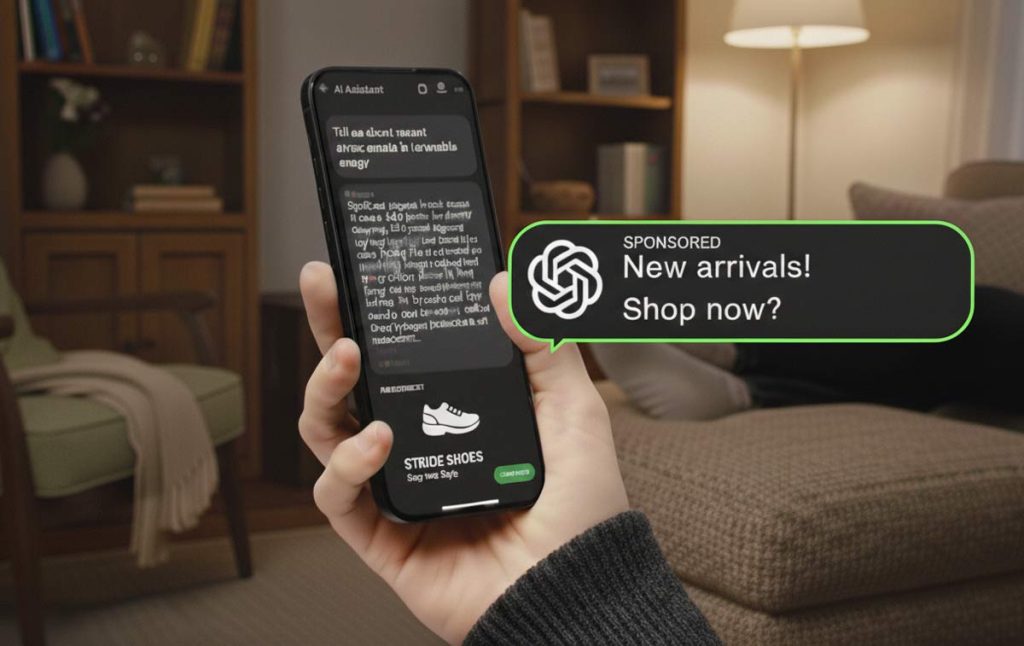
OpenAI has confirmed that it is actively testing advertising inside ChatGPT for free users in the United States. According to the company’s official announcement, “we’re testing advertisements in ChatGPT” with a focus on maintaining user experience while exploring new revenue streams. The ads are designed to appear at the bottom of responses, clearly labeled as sponsored, and separated from the main AI-generated content. While the program is still in early testing, this marks a major shift in how large language models may become monetized — and it introduces an entirely new acquisition channel for performance marketers.
Business Insider reports that OpenAI is targeting $25 billion in advertising revenue by 2030, positioning ChatGPT as a serious competitor to Google and Meta in the digital advertising landscape. This ambitious target suggests that OpenAI views advertising as a core business model, not just a supplementary revenue stream. For performance marketers, this means the platform is likely to receive serious investment in ad infrastructure, targeting capabilities, and measurement tools.
Unlike traditional display or social platforms, ChatGPT is not built around feeds, scrolling, or entertainment. It is a high-intent interface where users explicitly ask questions, seek recommendations, compare vendors, and evaluate solutions. That context makes ChatGPT advertising fundamentally different from almost every existing paid channel. According to ChatGPT’s own analysis, “ChatGPT ads will be most effective mid-to-lower funnel, capturing users who are actively comparing options or seeking final guidance.” This positions the platform as a complement to existing search and social strategies rather than a replacement.
While OpenAI moves forward with ads, competitors are taking a different approach. DeepMind CEO Demis Hassabis told TechRadar that Google’s Gemini will remain ad-free “at the moment,” creating a competitive dynamic where user experience may differentiate AI platforms. This creates an opportunity for early ChatGPT advertisers to establish presence in a channel where competitors may be absent.
How Will ChatGPT Advertising Work?
OpenAI has publicly stated several core principles in its help documentation. According to the company, “Ads will only be shown to adult users who are logged in to free tier accounts. Ads will be clearly labeled and separated from the conversational content. We will not use your conversations with ChatGPT to train models or for advertising purposes.” This privacy-first approach means advertisers will not receive access to individual user conversations, search queries, or behavioral profiles.
The ad unit itself is expected to be contextual — triggered by the subject of the conversation rather than by demographic or interest-based targeting. In practical terms, ChatGPT ads will function closer to “in-response sponsored recommendations” than to traditional search ads. The system evaluates the user’s prompt, determines commercial relevance, and may surface a sponsored placement below the answer. ChatGPT suggests that “the future of ChatGPT ads will likely focus on contextual relevance, ensuring ads align with real-time user queries.” This represents a significant departure from the behavioral targeting that dominates most digital advertising platforms.
OpenAI’s official announcement emphasizes this careful approach: “We’re committed to being thoughtful about when and how we show ads, and we’re starting with a small test in the US.” Early reports from Wired suggest that OpenAI is approaching this rollout cautiously, testing with select advertisers before opening the platform more broadly. This measured approach indicates that OpenAI is prioritizing platform health over rapid revenue growth — at least in the initial phase.
For more details on how advertisers will gain access to the platform, see our guide on ChatGPT ads setup and advertiser requirements. We also cover what ChatGPT ads will look like and how to create them in detail.
Key characteristics of early ChatGPT ads
The core features of ChatGPT advertising distinguish it from existing platforms in several important ways. Understanding these differences is critical for performance marketers evaluating whether to allocate budget to this channel.
- Contextual placement tied to conversation topic
- No access to raw user prompts or transcripts
- Clear labeling as sponsored content
- No demographic or interest targeting
- Ads will not appear near sensitive topics (health, mental health, politics)
- Privacy-first approach with no conversation data shared to advertisers
Will ChatGPT Ads Be CPC, CPM, or Something Else?
OpenAI has not officially announced a pricing model, creating uncertainty for advertisers planning budgets and evaluating ROI potential. However, early industry reporting and analysis from ChatGPT itself suggest the most likely models. According to ChatGPT, “Measurement will likely be CPC or CPM, with a focus on contextual engagement rather than demographic targeting.” This indicates that OpenAI may offer multiple pricing options depending on advertiser goals and campaign structure.
The first iteration of ChatGPT ads may be sold primarily on an impression-based model rather than cost-per-click. This is consistent with how new ad platforms often launch: limited inventory, controlled placement, and simplified buying mechanics. CPM models reward advertisers who can convert high-intent users efficiently, making landing page quality and offer clarity even more critical than in traditional search advertising.
Longer term, it is reasonable to expect a hybrid model. As the platform matures, OpenAI could introduce cost-per-click, cost-per-action, or even conversation-level conversion tracking. But in the early phase, advertisers should assume CPM-style buying with limited optimization controls. This means performance will depend heavily on message-market fit and the quality of the landing page experience rather than sophisticated bidding strategies.
For comprehensive analysis of pricing models, budget scenarios, and ROI expectations, read our detailed guide on ChatGPT ads pricing and budget planning.
Pricing model comparison
Different pricing models create different strategic imperatives for advertisers. Understanding how each model works and what it optimizes for will help performance teams allocate budget effectively and set realistic expectations for early-stage testing.
| Model | How it would work | Implication for marketers |
|---|---|---|
| CPM | Pay per 1,000 ad impressions | Brand + consideration focus, requires strong conversion rates |
| CPC | Pay per click on ad | Direct response friendly, rewards compelling ad copy |
| CPA | Pay per conversion event | Requires deep platform tracking and attribution infrastructure |
How Would You Track ChatGPT Ads Separately from Organic AI Traffic?
One of the most important operational questions is attribution. ChatGPT already drives significant “dark traffic” — users clicking links in AI tools that show up as direct or unassigned in analytics. When paid ads enter the picture, separating paid from organic AI influence becomes critical for accurate performance measurement and budget allocation decisions.
The simplest and most robust approach is UTM-based tracking. Every ChatGPT ad should use dedicated campaign parameters so that traffic is clearly labeled inside GA4, HubSpot, or any CRM. ChatGPT’s own guidance reinforces this: “To separate ad traffic from organic ChatGPT mentions, use distinct tracking parameters.” This allows performance teams to isolate paid ChatGPT traffic from organic citations and measure true incremental impact.
Organic ChatGPT traffic, by contrast, will still largely appear as direct, referral-less, or “not set” in analytics. The only practical way to estimate organic AI impact is through behavioral pattern analysis: landing page spikes, branded query growth, and assisted conversion paths. For agencies managing multiple clients or running sophisticated marketing analytics setups, establishing clear attribution frameworks now will prevent confusion when ChatGPT ads go live at scale.
For a complete guide to tracking implementation, UTM structure, and analytics configuration, see our detailed article on ChatGPT ad tracking and attribution.
Recommended attribution structure
A well-structured UTM taxonomy makes it possible to separate ChatGPT paid traffic from organic AI traffic, compare performance across channels, and track campaign-level ROI. This structure should be implemented consistently across all ChatGPT ad placements.
- utm_source=chatgpt
- utm_medium=paid
- utm_campaign=chatgpt-launch (or specific campaign identifier)
- utm_content=ad-variant-1 (for A/B testing different ad copy)
- utm_term=contextual-topic (optional, for topic-level tracking)
Will Advertisers See What Users Typed?
Short answer: almost certainly not. OpenAI’s help documentation explicitly states: “We will not use your conversations with ChatGPT to train models or for advertising purposes.” This means there will be no raw query reports like Google Ads search term data. ChatGPT confirms this limitation: “You won’t get exact user queries, but may get aggregated insights.” This privacy-first approach protects user trust but limits advertiser visibility into what triggers ad placements.
At best, advertisers should expect aggregated insight categories: topic clusters, intent groupings, or high-level keyword themes. This is similar to how modern privacy-first ad platforms operate — useful for optimization, but not exploitable at the individual prompt level. Discussion on Reddit from the OpenAI community highlights this privacy-first approach as a key differentiator from traditional search advertising.
The absence of search term visibility means advertisers will need to optimize based on conversion data and aggregate performance metrics rather than query-level refinement. This shifts the optimization focus from keyword management to creative testing, landing page quality, and offer clarity. Performance teams accustomed to granular search term reports will need to adapt their workflows and measurement strategies accordingly.
For more on what data advertisers will and won’t receive, read our analysis of ChatGPT search term data and advertiser visibility.
What Stage of the Funnel Is ChatGPT Best For?
ChatGPT sits in a uniquely powerful part of the marketing funnel. Users are not passively browsing; they are actively seeking answers, vendors, tools, and recommendations. This places ChatGPT primarily in the mid-to-lower funnel — the consideration and evaluation stage. As ChatGPT itself notes, “ChatGPT ads will be most effective mid-to-lower funnel, capturing users who are actively comparing options or seeking final guidance.”
This funnel positioning has significant strategic implications. ChatGPT ads are unlikely to be effective for pure awareness campaigns where users have no existing problem awareness or category familiarity. Instead, the platform excels when users are asking evaluative questions: “what’s the best CRM for a 50-person sales team,” “should I hire an agency or build marketing in-house,” or “which industrial generator supplier offers the fastest delivery times.” These are high-intent, high-consideration queries where conversational AI recommendations carry significant weight.
For B2B especially, this is where ChatGPT becomes extremely interesting: software selection, agency evaluation, tool comparisons, operational decision-making. Companies already running strong Google Ads campaigns will find ChatGPT ads complement their existing search strategy by capturing users at the exact moment they’re evaluating options. The key is to position ads as helpful recommendations rather than interruptive promotions.
Funnel stage effectiveness
Different funnel stages require different creative approaches and performance expectations. Understanding where ChatGPT fits helps marketers set realistic KPIs and allocate budget appropriately across channels.
| Funnel Stage | ChatGPT Fit | Why |
|---|---|---|
| Awareness | Medium | Limited reach, high intent users only |
| Consideration | High | Users asking “what should I choose?” |
| Decision | Very High | Vendor comparison, buying questions, final evaluation |
What Does Targeting Look Like Without Demographics?
ChatGPT targeting will be fundamentally contextual. There is no social graph, no behavioral history, and no demographic profiling. The only reliable signal is the user’s current intent expressed in their conversation. This represents a major departure from the audience targeting that dominates platforms like Meta, LinkedIn, and programmatic display.
From a strategic standpoint, this makes ChatGPT closer to “AI-powered search intent” than to interest-based advertising. For marketers accustomed to granular audience targeting — layering job titles, company sizes, interests, and behaviors — this represents a significant shift. Success on ChatGPT will reward strong messaging and offer-market fit over sophisticated segmentation. Advertisers who can articulate clear value propositions and differentiate effectively in competitive categories will outperform those relying on narrow audience targeting.
The absence of demographic targeting also means that ad creative must work across a broader audience. Unlike LinkedIn ads where you can tailor messaging to specific job functions or seniority levels, ChatGPT ads need to resonate with anyone asking relevant questions regardless of their role or background. This creates both a constraint (less personalization) and an opportunity (force clarity and universal value propositions).
For detailed strategies on optimizing contextual campaigns without demographic data, see our guide on contextual targeting in ChatGPT ads.
Likely targeting levers
While demographic targeting will not be available, advertisers will still have some control over when and where ads appear. These contextual targeting options will determine ad relevance and performance.
- Conversation topic (primary targeting mechanism)
- Commercial relevance and purchase intent signals
- Brand safety filters and topic exclusions
- Category inclusion/exclusion (e.g., avoid appearing in certain industries)
- Geographic targeting (likely market-level, not hyper-local)
What Could $100 vs $1,000 Per Month Actually Buy?
Because pricing is not public, any numbers are hypothetical. But if early CPMs land in the $20–$40 range (reasonable for premium contextual inventory), budget scenarios look roughly like this. ChatGPT’s analysis suggests that “with $100 per month, you might only test lightly; with $1,000, you could get meaningful insights.” This aligns with typical minimum thresholds for statistically significant testing on new ad platforms.
At $100/month, ChatGPT ads would function more as brand presence than performance channel. The impression volume would be too low to generate statistically significant conversion data or meaningful optimization signals. This budget level might make sense for highly specialized B2B offers with very narrow target audiences, but most advertisers will struggle to generate actionable insights at this scale.
At $1,000/month, you begin to collect enough volume to evaluate conversion rates, message-market fit, and funnel impact. This is the minimum budget level where performance teams can run meaningful A/B tests, compare different creative approaches, and make data-driven optimization decisions. For most B2B companies, this represents an experimental budget allocation — enough to validate the channel without over-committing resources.
Budget scenario comparison
Different budget levels generate different levels of statistical confidence and optimization opportunity. Understanding these thresholds helps marketers set realistic expectations for early-stage testing.
| Monthly Budget | Estimated Impressions (at $30 CPM) | What that means |
|---|---|---|
| $100 | ~3,300 | Exploratory visibility only, insufficient for optimization |
| $500 | ~16,600 | Early signal detection, basic creative testing possible |
| $1,000 | ~33,300 | Real testing + learning, statistically significant data |
| $5,000 | ~166,600 | Full optimization capability, multi-variant testing |
What Does OpenAI’s $25 Billion Revenue Target Mean for Advertisers?
Business Insider reports that OpenAI is targeting $25 billion in advertising revenue by 2030. To put this in context, that would make ChatGPT ads a major player in digital advertising — though still significantly smaller than Google’s $200+ billion annual ad revenue or Meta’s $130+ billion. This ambitious target suggests that OpenAI views advertising as a core business model, not just a supplementary revenue stream.
Achieving $25 billion in ad revenue will require either very high CPMs, significant ad volume, or both. The company’s stated commitment to user experience will be tested as revenue pressure increases. Performance marketers should watch for signs of increasing ad density, expanded placement options, or changes to the privacy-first policies that currently differentiate ChatGPT from traditional ad platforms.
The revenue target also signals that OpenAI is serious about building advertiser infrastructure. Expect investment in measurement tools, reporting dashboards, creative optimization features, and potentially self-serve platform capabilities. Early adopters who establish presence now may benefit from preferential treatment and favorable economics as the platform scales. However, the same revenue pressure that drives investment could also lead to aggressive monetization that degrades user experience — a pattern documented by Cory Doctorow in his analysis of platform enshittification.
Should Performance Teams Care About ChatGPT Ads Yet?
Yes — but with realistic expectations. This will not replace Google Ads, SEO, or paid social. What it introduces is a new layer in the buyer journey: a conversational decision engine where brands can appear exactly when users are asking for solutions. ChatGPT emphasizes that advertisers should “prepare tracking, landing pages, and success metrics early” rather than waiting for full platform availability.
For agencies and growth teams, ChatGPT ads should be treated as an experimental mid-funnel channel. The real opportunity is not just the ad unit itself, but the long-term shift in how discovery, evaluation, and buying behavior increasingly flows through AI systems. Users are already turning to ChatGPT for vendor recommendations, product comparisons, and buying advice — the question is whether your brand appears in those conversations.
If your marketing strategy already includes strong paid search, SEO, marketing automation, and attribution infrastructure, ChatGPT ads will eventually become a natural extension of your performance stack — not a replacement, but a new intent layer on top of it. The key is to start preparing now: establish attribution frameworks, understand how contextual AI targeting differs from traditional channels, and position your brand to appear in the conversational layer where buying decisions are increasingly being made.